AI for Security: AI-assisted security analysis for Web3 (smart contracts, blockchain clients, on-chain txs, etc.) and complex software systems.
AI Agent Security: Security and trustworthiness of autonomous agents and AI-native systems.
AI for Program Analysis: Combining AI with program analysis for software understanding, testing, and security.
My work includes 8 papers published at top-tier (CCF-A) venues, including ICSE, ISSTA, USENIX Security, TOSEM, TSE, and TIFS. Beyond academic research, ongoing work includes real-world vulnerability discovery, PoC development, and open-source security tooling. Selected projects include , and DarkNavySecurity/web3-skills.
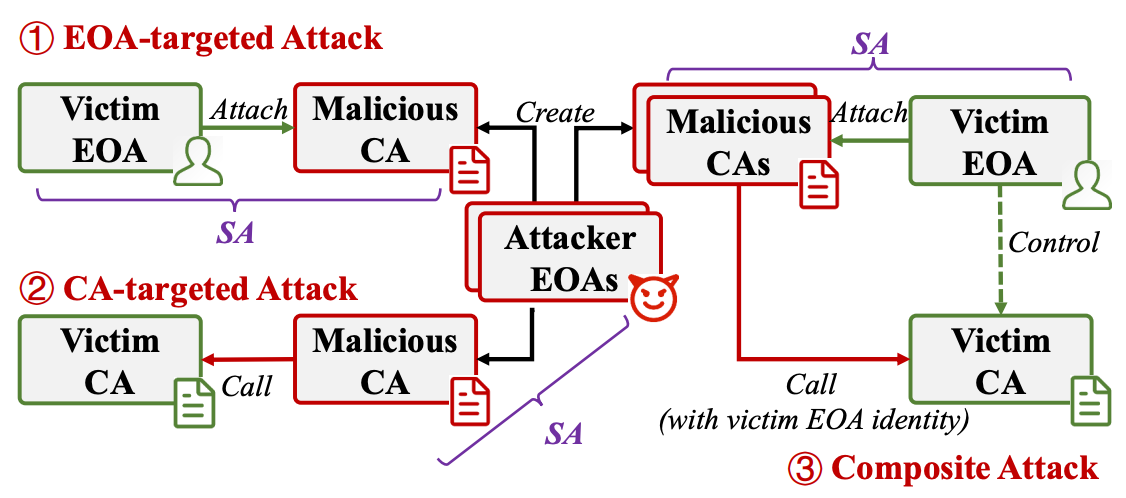
The introduction of smart accounts by EIP-7702 represents a major advancement for blockchain account abstraction, enabling externally owned accounts (EOAs) to be upgraded into programmable accounts while still preserving their original addresses. This advancement significantly enhances both account functionality and usability, but also redefines blockchain trust boundaries between EOAs and smart contract accounts (CAs), thereby altering security assumptions and creating opportunities for novel types of attack. To systematically examine these risks, we classify smart account-based risks into three categories according to the type of victim accounts: EOA-targeted, CA-targeted, and composite attacks. We then develop specialized detection tools that combine large-scale transaction analysis with cross-contract static analysis to identify malicious behaviors. Applying these tools across seven blockchains that support EIP-7702, we detect 924 malicious contract accounts, including several previously unreported zero-day cases. These attacks have led to more than 2.3 million in losses and exposed over 10 million to potential compromise. We uncover multiple key insights into attacker behaviors. Specifically, we find that over 63% of EIP-7702 authorization transactions are associated with malicious EOA-targeted attacks, and nearly half of the most frequently authorized contracts are controlled by attackers. In addition, we identify existing evasion tactics that attackers use to circumvent detection, attack impacts observed in real-world incidents, and potential risks that may emerge in future deployments, underscoring the urgency of addressing smart account security in blockchain ecosystems.
@inproceedings{yang2026eip7702,title={Revealing the Dark Side of Smart Accounts: An Empirical Study of EIP-7702 Incurred Risks in Blockchain Ecosystem},author={Huang, Mingyuan and Liu, Han and Yang, Shuo and Wu, Daoyuan and Wang, Shuai},booktitle={35th USENIX Security Symposium (USENIX Security 26)},year={2026},month=aug,publisher={USENIX Association},}
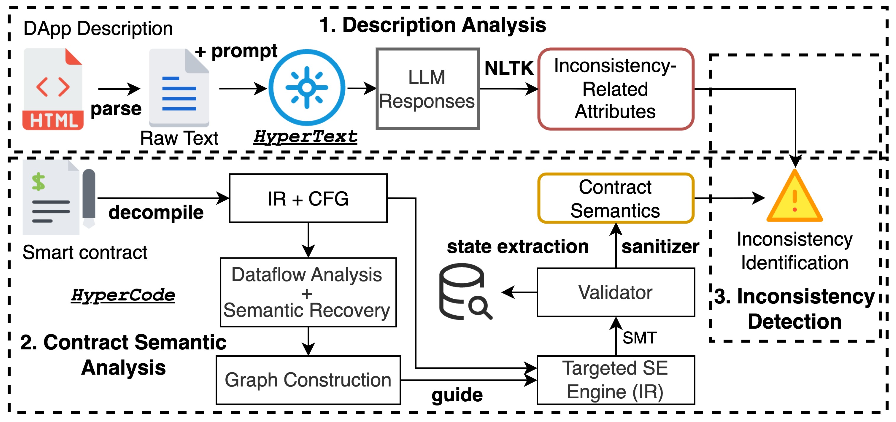
The rapid advancement of blockchain platforms has significantly accelerated the growth of decentralized applications (DApps). Similar to traditional applications, DApps integrate front-end descriptions that showcase their features to attract users, and back-end smart contracts for executing their business logic. However, inconsistencies between the features promoted in front-end descriptions and those actually implemented in the contract can confuse users and undermine DApps’s trustworthiness. In this paper, we first conducted an empirical study to identify seven types of inconsistencies, each exemplified by a real-world DApp. Furthermore, we introduce Hyperion, an approach designed to automatically identify inconsistencies between front-end descriptions and back-end code implementation in DApps. This method leverages a fine-tuned large language model LLaMA2 to analyze DApp descriptions and employs dataflow-guided symbolic execution for contract bytecode analysis. Finally, Hyperion reports the inconsistency based on predefined detection patterns. The experiment on our ground truth dataset consisting of 54 DApps shows that Hyperion reaches 84.06% overall recall and 92.06% overall precision in reporting DApp inconsistencies. We also implement Hyperion to analyze 835 real-world DApps. The experimental results show that Hyperion discovers 459 real-world DApps containing at least one inconsistency.
@inproceedings{yang2025hyperion,title={Hyperion: Unveiling DApp Inconsistencies Using LLM and Dataflow-Guided Symbolic Execution},author={Yang, Shuo and Lin, Xingwei and Chen, Jiachi and Zhong, Qingyuan and Xiao, Lei and Huang, Renke and Wang, Yanlin and Zheng, Zibin},booktitle={Proceedings of the IEEE/ACM 47th International Conference on Software Engineering},series={ICSE '25},pages={2125--2137},year={2025},month=apr,publisher={IEEE},doi={10.1109/ICSE55347.2025.00015},}
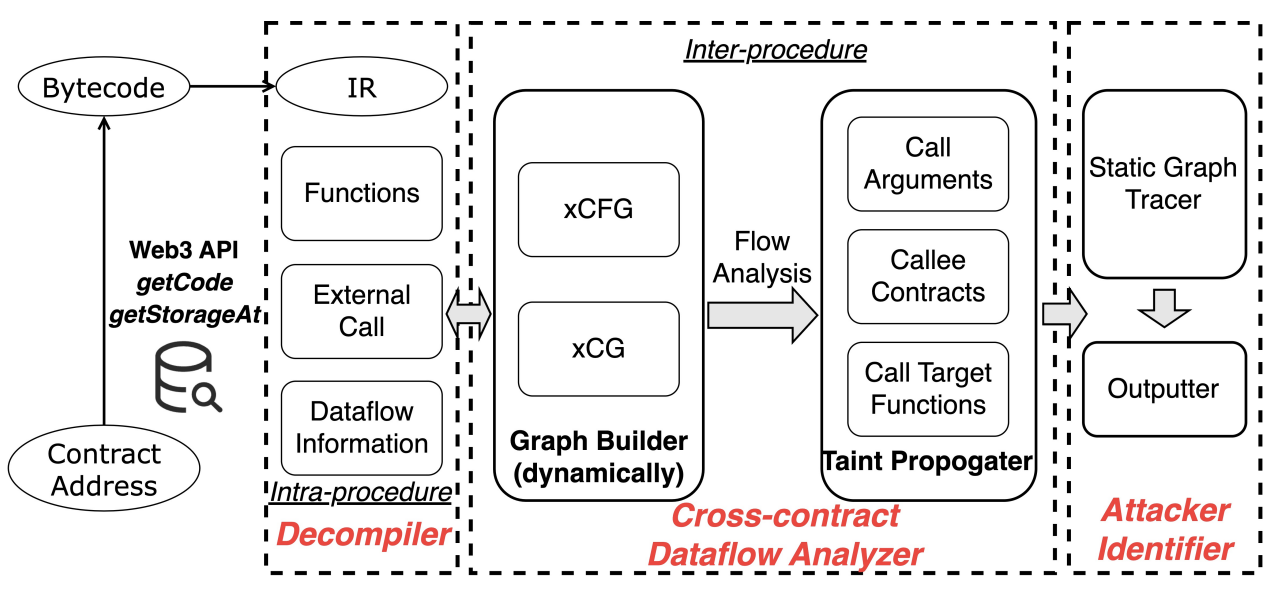
Reentrancy, a notorious vulnerability in smart contracts, has led to millions of dollars in financial loss. However, current smart contract vulnerability detection tools suffer from a high false positive rate in identifying contracts with reentrancy vulnerabilities. Moreover, only a small portion of the detected reentrant contracts can actually be exploited by hackers, making these tools less effective in securing the Ethereum ecosystem in practice. In this paper, we propose BlockWatchdog, a tool that focuses on detecting reentrancy vulnerabilities by identifying attacker contracts. These attacker contracts are deployed by hackers to exploit vulnerable contracts automatically. By focusing on attacker contracts, BlockWatchdog effectively detects truly exploitable reentrancy vulnerabilities by identifying reentrant call flow. Additionally, BlockWatchdog is capable of detecting new types of reentrancy vulnerabilities caused by poor designs when using ERC tokens or user-defined interfaces, which cannot be detected by current rule-based tools. We implement BlockWatchdog using cross-contract static dataflow techniques based on attack logic obtained from an empirical study that analyzes attacker contracts from 281 attack incidents. BlockWatchdog is evaluated on 421,889 Ethereum contract bytecodes and identifies 113 attacker contracts that target 159 victim contracts, leading to the theft of Ether and tokens valued at approximately 908.6 million USD. Notably, only 18 of the identified 159 victim contracts can be reported by current reentrancy detection tools.
@inproceedings{yang2024blockwatchdog,title={Uncover the Premeditated Attacks: Detecting Exploitable Reentrancy Vulnerabilities by Identifying Attacker Contracts},author={Yang, Shuo and Chen, Jiachi and Huang, Mingyuan and Zheng, Zibin and Huang, Yuan},booktitle={Proceedings of the IEEE/ACM 46th International Conference on Software Engineering},series={ICSE '24},pages={1--12},year={2024},month=apr,publisher={ACM},doi={10.1145/3597503.3639153},}
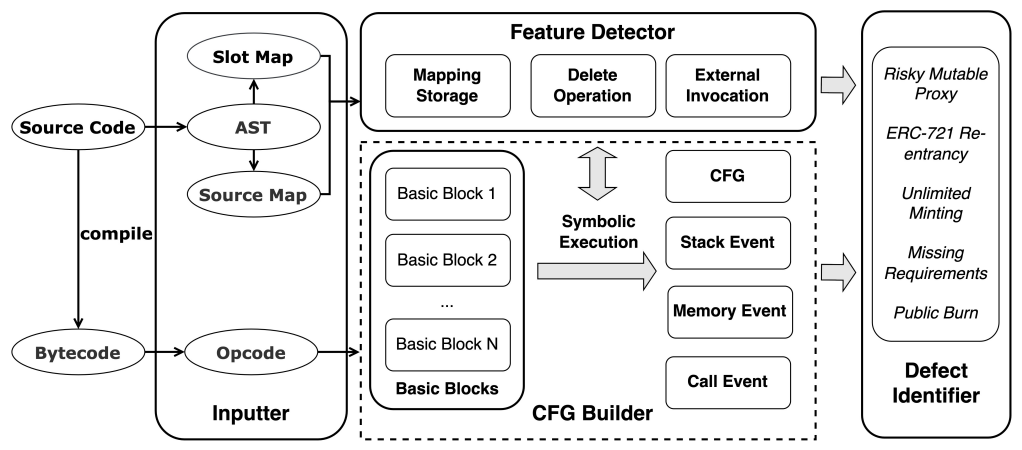
Recently, the birth of non-fungible tokens (NFTs) has attracted great attention. NFTs are capable of representing users’ ownership on the blockchain and have experienced tremendous market sales due to their popularity. Unfortunately, the high value of NFTs also makes them a target for attackers. The defects in NFT smart contracts could be exploited by attackers to harm the security and reliability of the NFT ecosystem. Despite the significance of this issue, there is a lack of systematic work that focuses on analyzing NFT smart contracts, which may raise worries about the security of users’ NFTs. To address this gap, in this paper, we introduce 5 defects in NFT smart contracts. Each defect is defined and illustrated with a code example highlighting its features and consequences, paired with possible solutions to fix it. Furthermore, we propose a tool named NFTGuard to detect our defined defects based on a symbolic execution framework. Specifically, NFTGuard extracts the information of the state variables from the contract abstract syntax tree (AST), which is critical for identifying variable-loading and storing operations during symbolic execution. Furthermore, NFTGuard recovers source-code-level features from the bytecode to effectively locate defects and report them based on predefined detection patterns. We run NFTGuard on 16,527 real-world smart contracts and perform an evaluation based on the manually labeled results. We find that 1,331 contracts contain at least one of the 5 defects, and the overall precision achieved by our tool is 92.6%.
@inproceedings{yang2023nftdefects,title={Definition and Detection of Defects in NFT Smart Contracts},author={Yang, Shuo and Chen, Jiachi and Zheng, Zibin},booktitle={Proceedings of the 32nd ACM SIGSOFT International Symposium on Software Testing and Analysis},series={ISSTA '23},pages={373--384},year={2023},month=jul,publisher={ACM},doi={10.1145/3597926.3598063},}
IEEE Transactions on Software Engineering (TSE, CCF-A, JCR Q1)
IEEE Transactions on Emerging Topics in Computational Intelligence (TETCI, JCR Q1)
Program Committee Member:
International Conference on Blockchain, Artificial Intelligence, and Trustworthy Systems (BlockSys 2026, CCF-C)
International Conference on Blockchain and Trustworthy Systems (BlockSys 2023, CCF-C)
Journal & Conference Sub-reviewer:
Journals: IEEE Transactions on Dependable and Secure Computing (TDSC, CCF-A), ACM Transactions on Software Engineering and Methodology (TOSEM, CCF-A), IEEE Internet of Things Journal (IoTJ, CCF-C), IEEE Transactions on Network Science and Engineering (TNSE), Blockchain: Research and Applications (BCRA, CCF-B)



 .
. 

 DarkNavy — Research Intern
  GoPlus — Research Intern
  Skyward Lab, Ant Group — Research Intern
  WeBank — Blockchain R&D Intern