Every project has a beautiful feature showcase page. It’s easy to include images in a flexible 3-column grid format. Make your photos 1/3, 2/3, or full width.
To give your project a background in the portfolio page, just add the img tag to the front matter like so:
---
layout: page
title: project
description: a project with a background image
img: /assets/img/12.jpg
---
Caption photos easily. On the left, a road goes through a tunnel. Middle, leaves artistically fall in a hipster photoshoot. Right, in another hipster photoshoot, a lumberjack grasps a handful of pine needles.
This image can also have a caption. It's like magic.
You can also put regular text between your rows of images, even citations (Yang et al., 2025). Say you wanted to write a bit about your project before you posted the rest of the images. You describe how you toiled, sweated, bled for your project, and then… you reveal its glory in the next row of images.
You can also have artistically styled 2/3 + 1/3 images, like these.
The code is simple. Just wrap your images with <div class="col-sm"> and place them inside <div class="row"> (read more about the Bootstrap Grid system). To make images responsive, add img-fluid class to each; for rounded corners and shadows use rounded and z-depth-1 classes. Here’s the code for the last row of images above:
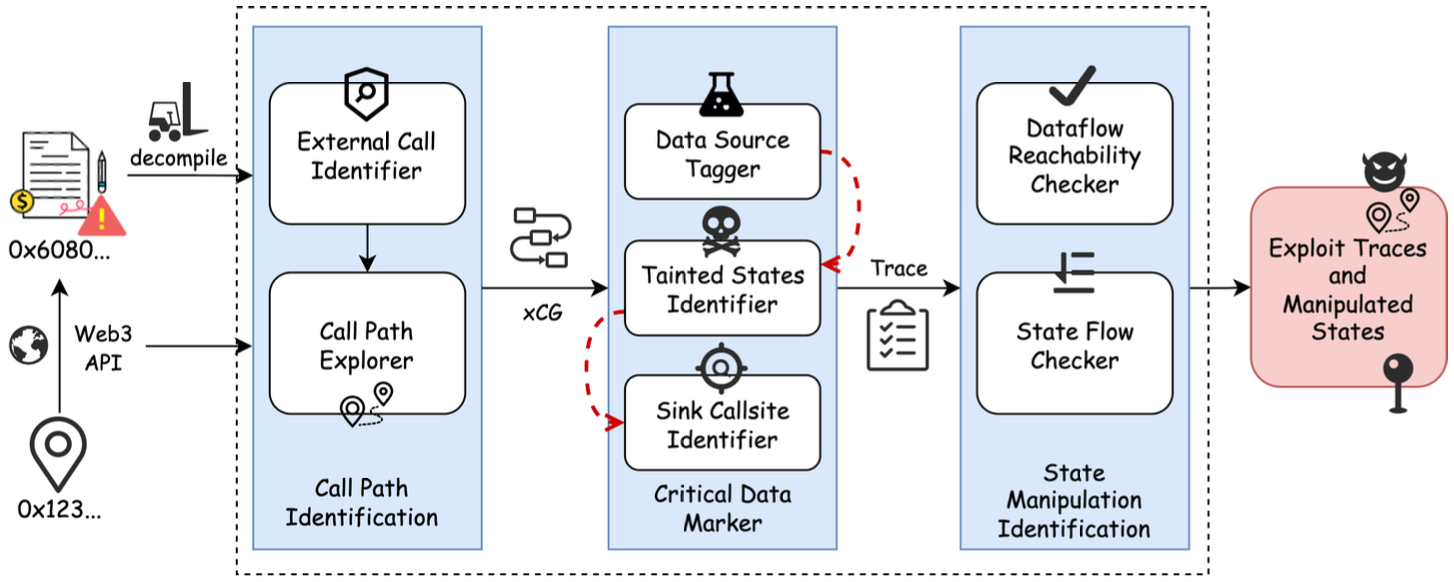
Recently, the increasing complexity of smart contracts and their interactions has led to more sophisticated strategies for executing attacks. Hackers often need to deploy attacker contracts as delegators to automate these attacks on their behalf. Existing identification methods for attacker contracts either rely on simple patterns (e.g., recursive callback control flow) that suffer from high false-positive rates and limited extraction of interaction and call information, or lack fully automated detection capabilities. Consequently, these limitations reduce the effectiveness of current solutions in identifying modern, intricate attacks. To overcome these challenges, we introduce the concept of state manipulation attacks, which abstracts the exploitation of problematic state dependencies arising from contract interactions. During these attacks, hackers first alter the storage state of one contract (the manipulated contract), which determines the profit they can gain. They then call another contract (the victim contract) to exploit its dependency on the altered state and maximize their profits. We present SMAsher, a tool designed to automatically identify state manipulation attacker contracts. SMAsher leverages fine-grained state-aware dataflow analysis to detect exploitation traces and exploited state dependencies among contracts, focusing on recovering the call path and interaction semantics. Our extensive experiments on 1.38 million real-world contracts demonstrate that SMAsher successfully identifies 311 state manipulation attacker contracts with 100% precision, resulting in $6.95 million in losses. Our findings also reveal some notable malicious characteristics of hackers’ accounts through their deployed attacker contracts. Additionally, we have provided 10 PoCs (Proof-of-Concepts) for previously unidentified attacks, all of which have been confirmed and released to the community.
@article{yang2025smasher,title={Who Is Pulling the Strings: Unveiling Smart Contract State Manipulation Attacks Through State-Aware Dataflow Analysis},author={Yang, Shuo and Chen, Jiachi and Xiao, Lei and Hu, Jinyuan and Lin, Dan and Wu, Jiajing and Zhang, Tao and Zheng, Zibin},journal={IEEE Transactions on Software Engineering},volume={51},number={10},pages={2942--2956},year={2025},month=oct,publisher={IEEE},doi={10.1109/TSE.2025.3605145},}